- Tue 09 May 2023
- nature
- Davide Castelvecchi

Borromean rings depicted in a church in Florence, Italy. If any one of the three rings is removed, the other two are no longer joined. Credit: Raphael Salzedo/Alamy
The coat of arms of Italy’s aristocratic House of Borromeo contains an unsettling symbol: an arrangement of three interlocking rings that that cannot be pulled apart but doesn’t contain any linked pairs.
That same three-way linkage is an unmistakable signature of one of the most coveted phenomena in quantum physics — and it has now been observed for the first time. Researchers have used a quantum computer to create virtual particles and move them around so that their paths formed a Borromean-ring pattern.
Welcome anyons! Physicists find best evidence yet for long-sought 2D structures
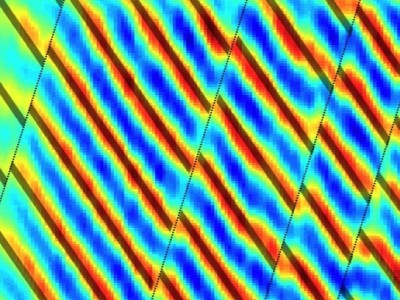
The exotic particles are called non-Abelian anyons, or nonabelions for short, and their Borromean rings exist only as information inside the quantum computer. But their linking properties could help to make quantum computers less error-prone, or more ‘fault-tolerant’ — a key step to making them outperform even the best conventional computers. The results, revealed in a preprint on 9 May 1 , were obtained on a machine at Quantinuum, a quantum-computing company in Broomfield, Colorado, that formed as a merger of the quantum computing unit of Honeywell and a start-up based in Cambridge, UK.
“This is the credible path to fault-tolerant quantum computing,” says Tony Uttley, Quantinuum’s president and chief operating officer.
Other researchers are less optimistic about the virtual nonabelions’ potential to revolutionize quantum computing, but creating them is seen as an achievement in itself. “There is enormous mathematical beauty in this type of physical system, and it’s incredible to see them realized for the first time, after a long time,” says Steven Simon, a theoretical physicist at the University of Oxford, UK.
Basket-weave doughnut
In the experiment, Henrik Dreyer, a physicist at Quantinuum’s office in Munich, Germany, and his collaborators used the company’s most advanced machine, called H2, which has a chip that can produce electric fields to trap 32 ions of the element ytterbium above its surface. Each ion can encode a qubit, a unit of quantum computation that can be ‘0’ or ‘1’ like ordinary bits, but also a superposition of both states simultaneously.
Quantinuum’s approach has an advantage: compared with most other types of qubits, the ions in its trap can be moved around and brought to interact with each other, which is how quantum computers perform computations.
Quantum computer race intensifies as alternative technology gains steam
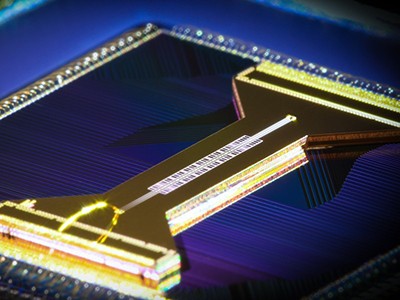
The physicists exploited this flexibility to create an unusually complex form of quantum entanglement, in which all 32 ions share the same quantum state. And by engineering those interactions, they created a virtual lattice of entanglement with the structure of a 27-qubit kagome — a pattern used in Japanese basket-weaving that resembles the repeated overlapping of six-pointed stars — folded to form a doughnut shape. The entangled states represented the lowest-energy states of a virtual 2D universe — essentially, the states that contain no particles at all. But with further manipulation, the kagome can be put in excited states. This corresponds to the appearance of particles that should have the properties of nonabelions.
To prove that the excited states were nonabelions, the team performed a series of tests. The most conclusive one consisted of moving the excited states around to create virtual Borromean rings. The appearance of the pattern was confirmed by measurements of the state of the ions during and after the operation, Dreyer says.
“No two particles are taken around each other, but all together they are linked,” says Ashvin Vishwanath, a theoretical physicist at Harvard University in Cambridge, Massachusetts, and a co-author of the paper. “It’s really an amazing state of matter that we don’t have a very clear realization of in any other set-up.”
Michael Manfra, an experimental physicist at Purdue University in West Lafayette, Indiana, says that although the results are impressive, the Quantinuum machine does not truly create nonabelions, but merely simulates some of their properties. But the authors say that the particles’ behaviour satisfies the definition, and that for practical purposes they could still form a basis for quantum computing.
Quantum pedigree
Like the Borromeo family, nonabelions come with a storied genealogy in both physics and mathematics, including work that has led to several Nobel prizes and Fields medals . Nonabelions are a type of anyon, a particles that can only exist in a two-dimensional universe or in situations where matter is trapped in a 2D surface — for example at the interface of two solid materials.
The strange topology that is reshaping physics
Anyons defy one of physicists’ most cherished assumptions: that all particles belong to one of two categories — fermions or bosons. When two identical fermions switch positions, their quantum state, called the wavefunction, is flipped by 180 degrees. But when bosons are switched, their wavefunction is unchanged.
When two anyons are switched, on the other hand, neither of these two options applies. Instead, for standard, ‘Abelian’ anyons, the wavefunction is shifted by a certain angle, different from fermions’ 180 degrees. Non-Abelian anyons respond by changing their quantum state in a more complex way — which is crucial because it should enable them to perform quantum computations that are non-Abelian, meaning that they produce different outcomes if performed in a different order.
Topological robustness
Nonabelions could also offer an advantage over most other ways of doing quantum computing. Ordinarily, the information in an individual qubit tends to degrade quickly, producing errors — something that has limited progress towards useful quantum computing. Physicists have developed various error-correction schemes that would require encoding a qubit in the collective quantum state of many atoms, potentially thousands.
But nonabelions should make that task a lot easier, because the paths they trace when they are looped around one another should be robust to errors. Perturbations such as magnetic disturbances might slightly move the paths around without changing the qualitative nature of their linking, called their topology.
Underdog technologies gain ground in quantum-computing race
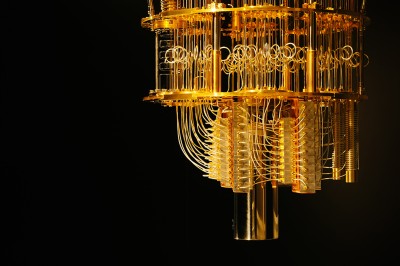
The concept of nonabelions and their potential as ‘topological qubits’ was first proposed 20 years ago by theoretical physicist Alexei Kitaev, now at the California Institute of Technology in Pasadena 2 . Physicists including Manfra have been aiming to create states of matter that naturally contain nonabelions and can therefore serve as the platform for topological qubits. Microsoft has made topological qubits its preferred approach to developing a quantum computer.
Vishwanath says that the nonabelions in Quantinuum’s machine are an important initial step. “To get into that game — to be even a contender for a topological quantum computer — the first step you need to take is to create such a state,” he says.
Simon says that the virtual nonabelion approach could be useful for quantum computations, but that it remains to be seen whether it will be more efficient than other error-correction schemes — some of which are also topologically inspired. The physical anyons that both Manfra and Microsoft are working on would be topologically robust out of the box. Dreyer says that, at the moment, it is still unclear how efficient his team’s nonabelions will turn out to be.
article_text: The coat of arms of Italy’s aristocratic House of Borromeo contains an unsettling symbol: an arrangement of three interlocking rings that that cannot be pulled apart but doesn’t contain any linked pairs. That same three-way linkage is an unmistakable signature of one of the most coveted phenomena in quantum physics — and it has now been observed for the first time. Researchers have used a quantum computer to create virtual particles and move them around so that their paths formed a Borromean-ring pattern.
Welcome anyons! Physicists find best evidence yet for long-sought 2D structures
The exotic particles are called non-Abelian anyons, or nonabelions for short, and their Borromean rings exist only as information inside the quantum computer. But their linking properties could help to make quantum computers less error-prone, or more ‘fault-tolerant’ — a key step to making them outperform even the best conventional computers. The results, revealed in a preprint on 9 May1, were obtained on a machine at Quantinuum, a quantum-computing company in Broomfield, Colorado, that formed as a merger of the quantum computing unit of Honeywell and a start-up based in Cambridge, UK. “This is the credible path to fault-tolerant quantum computing,” says Tony Uttley, Quantinuum’s president and chief operating officer. Other researchers are less optimistic about the virtual nonabelions’ potential to revolutionize quantum computing, but creating them is seen as an achievement in itself. “There is enormous mathematical beauty in this type of physical system, and it’s incredible to see them realized for the first time, after a long time,” says Steven Simon, a theoretical physicist at the University of Oxford, UK. In the experiment, Henrik Dreyer, a physicist at Quantinuum’s office in Munich, Germany, and his collaborators used the company’s most advanced machine, called H2, which has a chip that can produce electric fields to trap 32 ions of the element ytterbium above its surface. Each ion can encode a qubit, a unit of quantum computation that can be ‘0’ or ‘1’ like ordinary bits, but also a superposition of both states simultaneously. Quantinuum’s approach has an advantage: compared with most other types of qubits, the ions in its trap can be moved around and brought to interact with each other, which is how quantum computers perform computations.
Quantum computer race intensifies as alternative technology gains steam
The physicists exploited this flexibility to create an unusually complex form of quantum entanglement, in which all 32 ions share the same quantum state. And by engineering those interactions, they created a virtual lattice of entanglement with the structure of a 27-qubit kagome — a pattern used in Japanese basket-weaving that resembles the repeated overlapping of six-pointed stars — folded to form a doughnut shape. The entangled states represented the lowest-energy states of a virtual 2D universe — essentially, the states that contain no particles at all. But with further manipulation, the kagome can be put in excited states. This corresponds to the appearance of particles that should have the properties of nonabelions. To prove that the excited states were nonabelions, the team performed a series of tests. The most conclusive one consisted of moving the excited states around to create virtual Borromean rings. The appearance of the pattern was confirmed by measurements of the state of the ions during and after the operation, Dreyer says. “No two particles are taken around each other, but all together they are linked,” says Ashvin Vishwanath, a theoretical physicist at Harvard University in Cambridge, Massachusetts, and a co-author of the paper. “It’s really an amazing state of matter that we don’t have a very clear realization of in any other set-up.” Michael Manfra, an experimental physicist at Purdue University in West Lafayette, Indiana, says that although the results are impressive, the Quantinuum machine does not truly create nonabelions, but merely simulates some of their properties. But the authors say that the particles’ behaviour satisfies the definition, and that for practical purposes they could still form a basis for quantum computing. Like the Borromeo family, nonabelions come with a storied genealogy in both physics and mathematics, including work that has led to several Nobel prizes and Fields medals. Nonabelions are a type of anyon, a particles that can only exist in a two-dimensional universe or in situations where matter is trapped in a 2D surface — for example at the interface of two solid materials.
The strange topology that is reshaping physics
Anyons defy one of physicists’ most cherished assumptions: that all particles belong to one of two categories — fermions or bosons. When two identical fermions switch positions, their quantum state, called the wavefunction, is flipped by 180 degrees. But when bosons are switched, their wavefunction is unchanged. When two anyons are switched, on the other hand, neither of these two options applies. Instead, for standard, ‘Abelian’ anyons, the wavefunction is shifted by a certain angle, different from fermions’ 180 degrees. Non-Abelian anyons respond by changing their quantum state in a more complex way — which is crucial because it should enable them to perform quantum computations that are non-Abelian, meaning that they produce different outcomes if performed in a different order. Nonabelions could also offer an advantage over most other ways of doing quantum computing. Ordinarily, the information in an individual qubit tends to degrade quickly, producing errors — something that has limited progress towards useful quantum computing. Physicists have developed various error-correction schemes that would require encoding a qubit in the collective quantum state of many atoms, potentially thousands. But nonabelions should make that task a lot easier, because the paths they trace when they are looped around one another should be robust to errors. Perturbations such as magnetic disturbances might slightly move the paths around without changing the qualitative nature of their linking, called their topology.
Underdog technologies gain ground in quantum-computing race
The concept of nonabelions and their potential as ‘topological qubits’ was first proposed 20 years ago by theoretical physicist Alexei Kitaev, now at the California Institute of Technology in Pasadena2. Physicists including Manfra have been aiming to create states of matter that naturally contain nonabelions and can therefore serve as the platform for topological qubits. Microsoft has made topological qubits its preferred approach to developing a quantum computer. Vishwanath says that the nonabelions in Quantinuum’s machine are an important initial step. “To get into that game — to be even a contender for a topological quantum computer — the first step you need to take is to create such a state,” he says. Simon says that the virtual nonabelion approach could be useful for quantum computations, but that it remains to be seen whether it will be more efficient than other error-correction schemes — some of which are also topologically inspired. The physical anyons that both Manfra and Microsoft are working on would be topologically robust out of the box. Dreyer says that, at the moment, it is still unclear how efficient his team’s nonabelions will turn out to be. vocabulary:
{'non-Abelian anyons': '非阿贝尔任何子,是一种特殊的粒子,只能存在于二维宇宙或者物质被困在二维表面的情况下,当两个相同的非阿贝尔任何子交换位置时,它们的量子态(即波函数)不会被翻转180度,而是会被移动一定的角度,这与费米子和玻色子的行为不同','Borromean rings': '博罗梅恩环,是一种不可分离的三环结构,它们的连接属性可以帮助使量子计算机更加鲁棒,或者更加“容错”,这是使其比传统计算机更强大的关键一步','kagome': '加贺结构,是一种日本编织篮子的模式,它类似于重叠的六角星,可以折叠成甜甜圈的形状','qubit': '量子比特,是量子计算的基本单位,它可以是“0”或“1”,也可以同时是两者的组合','wavefunction': '波函数,是量子力学中用来描述粒子性质的函数','topology': '拓扑,是指物体的形状和空间结构','topological qubits': '拓扑量子比特,是一种量子计算的基本单位,它可以抵御错误,并且可以执行非阿贝尔量子计算','fault-tolerant': '容错,指的是系统能够抵御错误的能力','entanglement': '纠缠,指的是量子力学中的一种现象,它指的是两个或多个量子系统之间的相互作用','perturbations': '扰动,指的是对系统的外部影响,如磁场扰动','superposition': '叠加,指的是量子力学中的一种现象,它指的是一个量子系统可以同时处于多个状态','nonabelions': '非阿贝尔任何子,是一种特殊的粒子,只能存在于二维宇宙或者物质被困在二维表面的情况下,当两个相同的非阿贝尔任何子交换位置时,它们的量子态(即波函数)不会被翻转180度,而是会被移动一定的角度,这与费米子和玻色子的行为不同','Abelian anyons': '阿贝尔任何子,是一种特殊的粒子,当两个相同的阿贝尔任何子交换位置时,它们的量子态(即波函数)会被翻转180度','ytterbium': '镱,是一种元素,它可以用来编码量子比特','Alexei Kitaev': '亚历山大·基塔耶夫,俄罗斯理论物理学家,曾提出非阿贝尔任何子和它们的潜在作为拓扑量子比特的概念','Fields medal': '菲尔兹奖,是数学界最高荣誉,每四年颁发一次'} readguide:
{'reading_guide': '本文讲述了物理学家们在量子计算机上首次观测到非阿贝尔任何子(non-Abelian anyons),这种奇异粒子可以用来使量子计算机更加容错,从而使其性能超越传统计算机。文章还介绍了非阿贝尔任何子的特性,以及它们可能如何帮助量子计算机发挥更大的作用。'} long_sentences:
{'sentence 1': 'In the experiment, Henrik Dreyer, a physicist at Quantinuum’s office in Munich, Germany, and his collaborators used the company’s most advanced machine, called H2, which has a chip that can produce electric fields to trap 32 ions of the element ytterbium above its surface.', 'sentence 2': 'The exotic particles are called non-Abelian anyons, or nonabelions for short, and their Borromean rings exist only as information inside the quantum computer.'}
Sentence 1: 在实验中,来自德国慕尼黑Quantinuum办公室的物理学家Henrik Dreyer和他的同事们使用了该公司最先进的机器H2,该机器上有一个芯片,可以产生电场来捕获元素镱在其表面上的32个离子。
该句子是一个复合句,主句是“在实验中,Henrik Dreyer和他的同事们使用了该公司最先进的机器H2”,而从句则是“该机器上有一个芯片,可以产生电场来捕获元素镱在其表面上的32个离子”。从句中的主语是“一个芯片”,谓语动词是“可以产生电场来捕获元素镱在其表面上的32个离子”,而宾语则是“电场”和“元素镱在其表面上的32个离子”。句子的主旨是描述了Henrik Dreyer和他的同事们使用的机器H2的特性,即它上面有一个芯片,可以产生电场来捕获元素镱在其表面上的32个离子。
Sentence 2: 这些异常粒子被称为非阿贝尔任何子,或简称为非阿贝尔任何子,它们的博罗米安环只存在于量子计算机的信息中。
该句子是一个简单句,主语是“这些异常粒子”,谓语动词是“被称为”,而宾语则是“非阿贝尔任何子,或简称为非阿贝尔任何子”,而表语则是“它们的博罗米安环只存在于量子计算机的信息中”。句子的主旨是描述了这些异常粒子的特性,即它们被称为非阿贝尔任何子,它们的博罗米安环只存在于量子计算机的信息中。