- Mon 24 April 2023
- nature
- Davide Castelvecchi
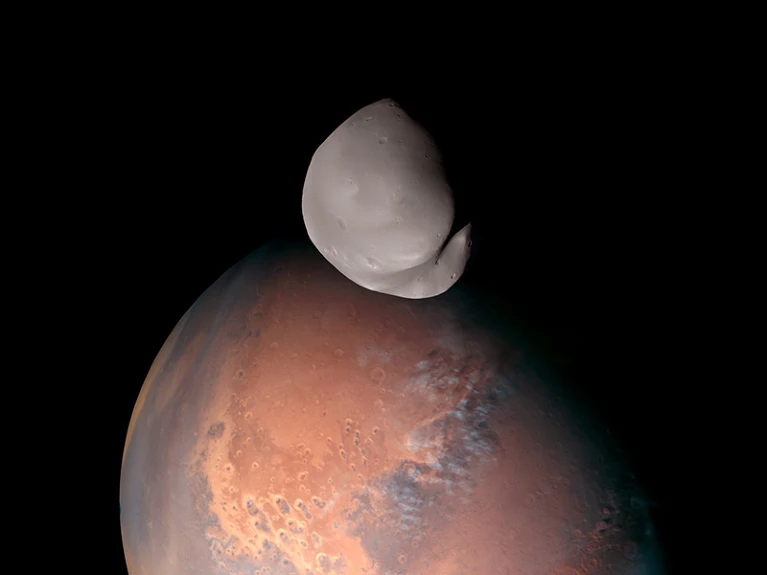
The moonlet Deimos is made of the same type of material as Mars, the latest observations suggest. Credit: Emirates Mars Mission
The United Arab Emirates’ space probe Hope has taken the first high-resolution images of the farside of Mars’s moonlet Deimos. The observations add weight to the theory that Deimos formed together with Mars, rather than as an asteroid that was captured in the planet’s orbit, mission scientists say.
Hope, formally known as the Emirates Mars Mission (EMM) , performed a fly-by — the first of many — on 10 March. EMM science lead Hessa Al Matroushi recalls the excitement when the first images streamed in, looking down at the 12.4-kilometre-wide moonlet. “Mars was in the background — and that was just mind blowing, honestly,” says Al Matroushi, who is at the Mohammed Bin Rashid Space Centre in Dubai, United Arab Emirates. She reported the results at the European Geosciences Union meeting in Vienna on 24 April.
Like Earth’s Moon, Deimos is tidally locked to its planet, meaning that any observations from a low Mars orbit or the planet’s surface are always of the same side of the moonlet.
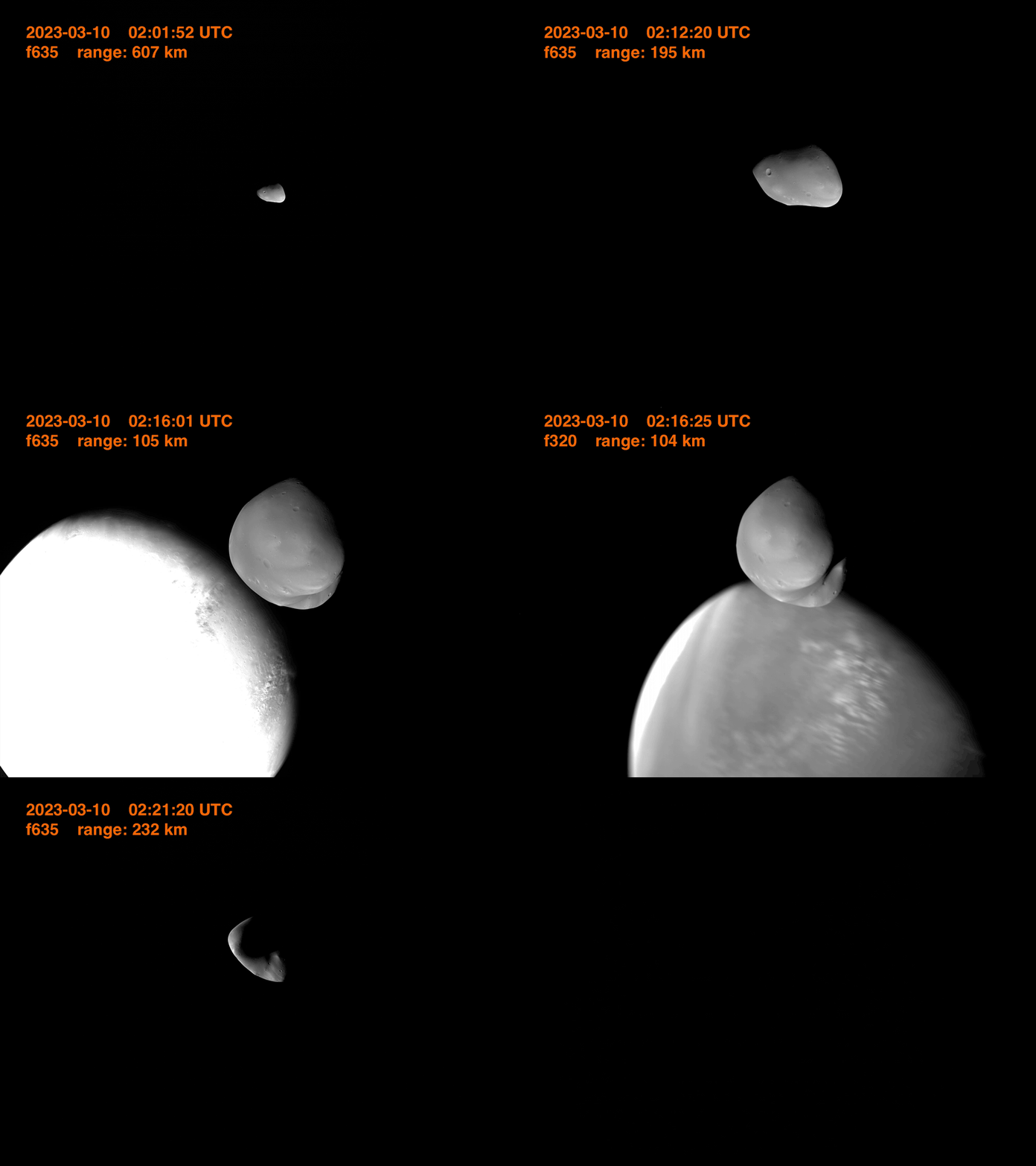
Hope’s closest encounter with Deimos reveals its irregular shape and asteroid pockmarks. Credit: Emirates Mars Mission
But compared with the flotilla of missions that have visited the red planet, Hope has an unusually high and elongated orbit, which reaches more than 40,000 kilometres above Mars’s surface at its highest point, explains Al Matroushi. This enables it to observe Deimos from above and to image its farside. (EMM is unable to visit Mars’s other natural satellite, Phobos, which circles the planet at less than 10,000 kilometres from the surface — lower than the lowest point in the probe’s orbit.)
During the 10 March fly-by, the mission team used all three onboard instruments to take readings spanning from the infrared to the extreme ultraviolet. The relatively flat spectrum the scientists saw is suggestive of the type of material seen on Mars’s surface, rather than the carbon-rich rock often found in asteroids, suggesting that Deimos was formed from the same material as the planet. “If there were carbon or organics, we would see spikes in specific wavelengths,” she says.

The Hope probe is the first to fly by Deimos. It captured stereo images during its closest pass, seen here in a 3D picture best viewed with red–cyan anaglyph glasses. Credit: Emirates Mars Mission
The 1.35-tonne, US$200-million spacecraft launched on a Japanese rocket in July 2020 and arrived at Mars in February 2021 . With frequent observations of Mars’s atmosphere, its main science goal was to study seasonal variations in the planet’s atmosphere and weather patterns. But once that phase was concluded with propellant to spare, mission control fired the onboard thrusters in a manoeuvre that allows the spacecraft to intersect with Deimos’s orbit multiple times. “We don’t want to get a one-time observation of Deimos,” says Al Matroushi. “We knew we wanted more.”
article_text: The United Arab Emirates’ space probe Hope has taken the first high-resolution images of the farside of Mars’s moonlet Deimos. The observations add weight to the theory that Deimos formed together with Mars, rather than as an asteroid that was captured in the planet’s orbit, mission scientists say. Hope, formally known as the Emirates Mars Mission (EMM), performed a fly-by — the first of many — on 10 March. EMM science lead Hessa Al Matroushi recalls the excitement when the first images streamed in, looking down at the 12.4-kilometre-wide moonlet. “Mars was in the background — and that was just mind blowing, honestly,” says Al Matroushi, who is at the Mohammed Bin Rashid Space Centre in Dubai, United Arab Emirates. She reported the results at the European Geosciences Union meeting in Vienna on 24 April. Like Earth’s Moon, Deimos is tidally locked to its planet, meaning that any observations from a low Mars orbit or the planet’s surface are always of the same side of the moonlet. But compared with the flotilla of missions that have visited the red planet, Hope has an unusually high and elongated orbit, which reaches more than 40,000 kilometres above Mars’s surface at its highest point, explains Al Matroushi. This enables it to observe Deimos from above and to image its farside. (EMM is unable to visit Mars’s other natural satellite, Phobos, which circles the planet at less than 10,000 kilometres from the surface — lower than the lowest point in the probe’s orbit.) During the 10 March fly-by, the mission team used all three onboard instruments to take readings spanning from the infrared to the extreme ultraviolet. The relatively flat spectrum the scientists saw is suggestive of the type of material seen on Mars’s surface, rather than the carbon-rich rock often found in asteroids, suggesting that Deimos was formed from the same material as the planet. “If there were carbon or organics, we would see spikes in specific wavelengths,” she says. The 1.35-tonne, US$200-million spacecraft launched on a Japanese rocket in July 2020 and arrived at Mars in February 2021. With frequent observations of Mars’s atmosphere, its main science goal was to study seasonal variations in the planet’s atmosphere and weather patterns. But once that phase was concluded with propellant to spare, mission control fired the onboard thrusters in a manoeuvre that allows the spacecraft to intersect with Deimos’s orbit multiple times. “We don’t want to get a one-time observation of Deimos,” says Al Matroushi. “We knew we wanted more.” vocabulary:
{'Tidally': '定潮:指某个天体(如月球)因受到另一天体(如地球)的引力而产生的潮汐作用,使其自转周期与公转周期相同','Flotilla': '小舰队:指由几艘舰艇组成的小型舰队','Propellant': '推进剂:指用于推动飞行器的物质','Intersect': '交叉:指两条线或两个曲线相交','Spectrum': '光谱:指由一系列光谱线组成的光谱图','Elongated': '延长:指物体的长度增加','Tidally locked': '定潮锁定:指某个天体(如月球)因受到另一天体(如地球)的引力而产生的潮汐作用,使其自转周期与公转周期相同','Farside': '远侧:指某个天体(如月球)的另一侧','Fly-by': '飞越:指飞行器以一定的速度经过某个地点','Elongated orbit': '延长轨道:指飞行器的轨道长度增加','Tidally': '定潮:指某个天体(如月球)因受到另一天体(如地球)的引力而产生的潮汐作用,使其自转周期与公转周期相同','Spectral': '光谱的:指由一系列光谱线组成的光谱图','Manoeuvre': '机动:指飞行器的机动操作','Intersect': '交叉:指两条线或两个曲线相交','Tidally locked': '定潮锁定:指某个天体(如月球)因受到另一天体(如地球)的引力而产生的潮汐作用,使其自转周期与公转周期相同','Spectrum': '光谱:指由一系列光谱线组成的光谱图','Carbon-rich': '碳富集:指物质中碳元素的含量较高','Organics': '有机物:指由碳原子组成的化合物','Propellant': '推进剂:指用于推动飞行器的物质','Tidally': '定潮:指某个天体(如月球)因受到另一天体(如地球)的引力而产生的潮汐作用,使其自转周期与公转周期相同','Intersect': '交叉:指两条线或两个曲线相交','Spectrum': '光谱:指由一系列光谱线组成的光谱图','Manoeuvre': '机动:指飞行器的机动操作'} readguide:
{'reading_guide': '本文讲述了阿联酋的太空探测器“希望号”拍摄火星月球“迪摩斯”远侧的高分辨率图像,以及这一观测结果对“迪摩斯”形成机制的推断。“希望号”是2020年7月由日本火箭发射,2021年2月抵达火星的一颗1.35吨、耗资2亿美元的探测器,其主要科学目标是研究火星大气和气候变化的季节性变化。“希望号”的轨道高度达到4万公里,使其能够从上方观测“迪摩斯”,从而拍摄到远侧的图像。观测结果表明,“迪摩斯”的物质组成与火星表面的物质组成相似,而非经常被发现于小行星中的碳富含岩石,这一结果支持了“迪摩斯”与火星同时形成的理论。'} long_sentences:
{'sentence 1': 'But compared with the flotilla of missions that have visited the red planet, Hope has an unusually high and elongated orbit, which reaches more than 40,000 kilometres above Mars’s surface at its highest point, explains Al Matroushi.', 'sentence 2': 'The 1.35-tonne, US$200-million spacecraft launched on a Japanese rocket in July 2020 and arrived at Mars in February 2021.'}
Sentence 1: 但是,与曾经拜访红色星球的舰队相比,希望号有一个不寻常的高度和长度的轨道,其最高点达到超过4万公里的马斯表面,Al Matroushi解释说。
Sentence 2: 这艘1.35吨,价值2亿美元的航天器于2020年7月乘坐日本火箭发射,并于2021年2月抵达火星。
Sentence 1: 这句话是一个复合句,由主句和从句组成。主句是“But compared with the flotilla of missions that have visited the red planet, Hope has an unusually high and elongated orbit”,从句是“which reaches more than 40,000 kilometres above Mars’s surface at its highest point, explains Al Matroushi”。主句中的“Hope”是主语,“has”是谓语,“an unusually high and elongated orbit”是表语,“the flotilla of missions that have visited the red planet”是定语。从句中的“which”是关系代词,“reaches”是谓语,“more than 40,000 kilometres above Mars’s surface at its highest point”是状语,“Al Matroushi”是宾语。句子的意思是:与曾经拜访红色星球的舰队相比,希望号有一个不寻常的高度和长度的轨道,其最高点达到超过4万公里的马斯表面,Al Matroushi解释说。
Sentence 2: 这句话是一个简单句,由主语“The 1.35-tonne, US$200-million spacecraft”,谓语“launched”,宾语“on a Japanese rocket in July 2020 and arrived at Mars in February 2021”组成。句子的意思是:这艘1.35吨,价值2亿美元的航天器于2020年7月乘坐日本火箭发射,并于2021年2月抵达火星。