- Wed 26 April 2023
- nature
- Davide Castelvecchi
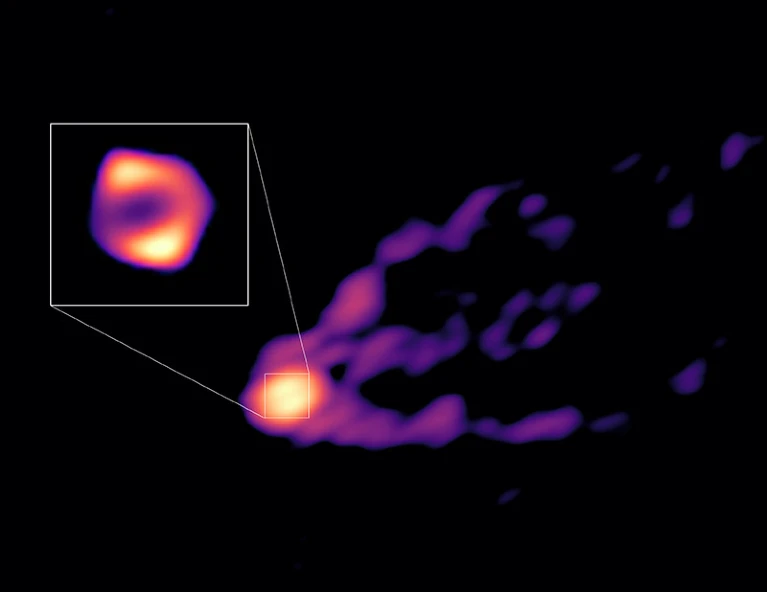
The latest image of the black hole M87* shows a three-pronged jet emerging from it. Credit: R.-S. Lu (SHAO) and E. Ros (MPIfR), S.Dagnello (NRAO/AUI/NSF)
The first image of a black hole wowed the world in 2019. Fresh data could now help to explain what exactly radio astronomers were looking at — including details of the maelstrom it creates. And in an updated image, the black hole’s original orange ring now appears thinner, courtesy of a new way of analysing the existing data.
The first-ever image of a black hole is now a movie
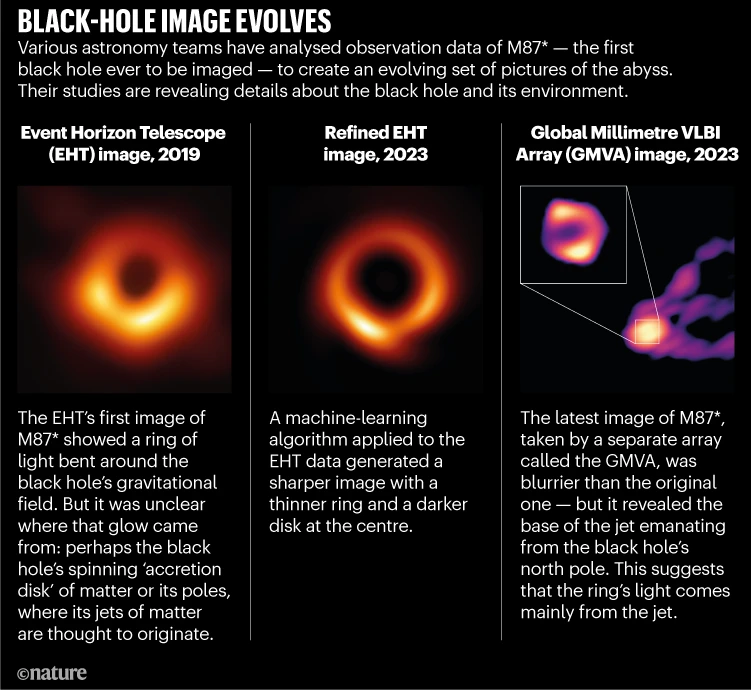
The picture that graced the front pages of newspapers around the globe in 2019 showed the supermassive black hole at the centre of the galaxy M87, called M87* (see ‘Black-hole image evolves’). By themselves, black holes do not emit any radiation, so the orange doughnut (representing radio-wavelength emissions) must have been produced not directly by the black hole, but by matter in its vicinity that is ‘superheated’ and twisted by magnetic fields. “Without any matter around, you would not even see a ring,” says Thomas Krichbaum, a radio astronomer at the Max Planck Institute for Radio Astronomy in Bonn, Germany. “Something has to radiate.”
The black hole’s gravity bent rays of light to produce the ring shape, as expected from Albert Einstein’s general theory of relativity. But although astrophysicists had theories, there was no clear indication — on the basis of that image alone — as to the origin of the radiation. The most likely explanation was that the glow resulted from the same mechanism that causes a stupendously bright jet of superheated matter to protrude far out from the host galaxy. The existence of this jet was known long before the black hole was imaged, and it had been photographed with more conventional instruments including the Hubble Space Telescope.
The bigger picture
The original M87* image was blurry, and showed only the immediate vicinity of the black hole’s event horizon, the spherical surface that shrouds its interior. Any material that crosses the event horizon falls inwards, never to return. It was challenging to link the image to the larger-scale pictures of the jet.
In a paper published in Nature on 26 April 1 , radio astronomers including Krichbaum crunched through a separate data set and found a cone of radio emissions emanating from the black hole in the same direction as the jet.
The original M87* image used 2017 data from the Event Horizon Telescope (EHT), a network of observatories scattered across four continents that examined the black hole at a wavelength of 1.3 millimetres. The latest paper used data taken in 2018 with the Global Millimetre VLBI Array (GMVA), a separate and older network that shares many collaborators with the EHT and uses some of the same facilities, but observes at 3.5 millimetres.
Black hole pictured for first time — in spectacular detail

Both networks use a technique called interferometry, which combines data taken simultaneously at multiple locations. The larger the separation between the participating observatories, the better the resolution and the more details astronomers can discern; going to shorter wavelengths has the same effect. With its lower resolution, the GMVA cannot see the ring as sharply as the EHT, and it needs some extra data massaging. But the GMVA is able to see a wider picture. “For the first time, we see how the jet connects to the ring,” says Krichbaum.
A different perspective
In a separate paper, published in The Astrophysical Journal Letters on 13 April 2 , astrophysicist Lia Medeiros at the Institute for Advanced Study in Princeton, New Jersey, and her collaborators reanalysed the 2017 EHT data using a new machine-learning algorithm.
Algorithms that process the telescope data must overcome an intrinsic limitation of interferometry: even with observatories on opposite sides of the planet, the array does not truly gather data with an Earth-sized dish, but with shards of one. “There is an infinite number of images that are consistent with our data,” Medeiros says. “You need to make a choice about which one you think is most likely.”
In the 2019 results, the EHT team used conservative algorithms that artificially blurred the image. Medeiros’s team developed an algorithm based on a technique called dictionary learning that maximizes the resolution — and produces a substantially thinner ring. Medeiros is eager to apply the technique to data on Sagittarius A*, the black hole at the centre of our Galaxy. The EHT released an image of Sagittarius A* last year.
The EHT has also produced various versions of the M87* images, including one showing signatures of magnetic fields , and has used older data to show how the ring has evolved over the years, in images that can be combined into a movie . The collaboration conducted observation campaigns in 2018 and once a year between 2021 and 2023, but has not yet finished analysing those data. Most intriguingly, the 2023 campaign included observations at the challenging wavelength of 0.87 millimetres, which should further improve the resolution.
article_text: The first image of a black hole wowed the world in 2019. Fresh data could now help to explain what exactly radio astronomers were looking at — including details of the maelstrom it creates. And in an updated image, the black hole’s original orange ring now appears thinner, courtesy of a new way of analysing the existing data.
The first-ever image of a black hole is now a movie
The picture that graced the front pages of newspapers around the globe in 2019 showed the supermassive black hole at the centre of the galaxy M87, called M87 (see ‘Black-hole image evolves’). By themselves, black holes do not emit any radiation, so the orange doughnut (representing radio-wavelength emissions) must have been produced not directly by the black hole, but by matter in its vicinity that is ‘superheated’ and twisted by magnetic fields. “Without any matter around, you would not even see a ring,” says Thomas Krichbaum, a radio astronomer at the Max Planck Institute for Radio Astronomy in Bonn, Germany. “Something has to radiate.” The black hole’s gravity bent rays of light to produce the ring shape, as expected from Albert Einstein’s general theory of relativity. But although astrophysicists had theories, there was no clear indication — on the basis of that image alone — as to the origin of the radiation. The most likely explanation was that the glow resulted from the same mechanism that causes a stupendously bright jet of superheated matter to protrude far out from the host galaxy. The existence of this jet was known long before the black hole was imaged, and it had been photographed with more conventional instruments including the Hubble Space Telescope. The original M87 image was blurry, and showed only the immediate vicinity of the black hole’s event horizon, the spherical surface that shrouds its interior. Any material that crosses the event horizon falls inwards, never to return. It was challenging to link the image to the larger-scale pictures of the jet. In a paper published in Nature on 26 April1, radio astronomers including Krichbaum crunched through a separate data set and found a cone of radio emissions emanating from the black hole in the same direction as the jet. The original M87* image used 2017 data from the Event Horizon Telescope (EHT), a network of observatories scattered across four continents that examined the black hole at a wavelength of 1.3 millimetres. The latest paper used data taken in 2018 with the Global Millimetre VLBI Array (GMVA), a separate and older network that shares many collaborators with the EHT and uses some of the same facilities, but observes at 3.5 millimetres.
Black hole pictured for first time — in spectacular detail
Both networks use a technique called interferometry, which combines data taken simultaneously at multiple locations. The larger the separation between the participating observatories, the better the resolution and the more details astronomers can discern; going to shorter wavelengths has the same effect. With its lower resolution, the GMVA cannot see the ring as sharply as the EHT, and it needs some extra data massaging. But the GMVA is able to see a wider picture. “For the first time, we see how the jet connects to the ring,” says Krichbaum. In a separate paper, published in The Astrophysical Journal Letters on 13 April2, astrophysicist Lia Medeiros at the Institute for Advanced Study in Princeton, New Jersey, and her collaborators reanalysed the 2017 EHT data using a new machine-learning algorithm. Algorithms that process the telescope data must overcome an intrinsic limitation of interferometry: even with observatories on opposite sides of the planet, the array does not truly gather data with an Earth-sized dish, but with shards of one. “There is an infinite number of images that are consistent with our data,” Medeiros says. “You need to make a choice about which one you think is most likely.” In the 2019 results, the EHT team used conservative algorithms that artificially blurred the image. Medeiros’s team developed an algorithm based on a technique called dictionary learning that maximizes the resolution — and produces a substantially thinner ring. Medeiros is eager to apply the technique to data on Sagittarius A, the black hole at the centre of our Galaxy. The EHT released an image of Sagittarius A last year. The EHT has also produced various versions of the M87* images, including one showing signatures of magnetic fields, and has used older data to show how the ring has evolved over the years, in images that can be combined into a movie. The collaboration conducted observation campaigns in 2018 and once a year between 2021 and 2023, but has not yet finished analysing those data. Most intriguingly, the 2023 campaign included observations at the challenging wavelength of 0.87 millimetres, which should further improve the resolution. vocabulary:
{'M87': 'M87:指银河M87中心的超大质量黑洞,是2019年第一张黑洞图片的主题','superheated': 'superheated:超热,指物质被磁场折腾而变得极度热','maelstrom': 'maelstrom:漩涡,指黑洞周围的极度混乱的状态','interferometry': 'interferometry:干涉测量,指通过多个位置同时收集数据,以获得更高分辨率的技术','event horizon': 'event horizon:事件视界,指黑洞的球形表面,任何物质都无法从其中返回','general theory of relativity': 'general theory of relativity:广义相对论,指爱因斯坦提出的物理学理论,用于解释重力','stupendously': 'stupendously:极度地,指物质被超热而发出的极其明亮的喷射','protrude': 'protrude:突出,指物质从宿主星系中喷射出来','Hubble Space Telescope': 'Hubble Space Telescope:哈勃太空望远镜,指一种用于观测宇宙的太空望远镜','doughnut': 'doughnut:甜甜圈,指黑洞图片中表示射频发射的橙色圆环','VLBI': 'VLBI:长基线干涉测量,指一种用于观测宇宙的技术,可以获得更高分辨率的数据','resolution': 'resolution:分辨率,指观测器仪能够辨认的最小物体的大小','simultaneously': 'simultaneously:同时,指多个观测器仪同时收集数据','shards': 'shards:碎片,指干涉测量中,观测器仪收集的数据碎片','dictionary learning': 'dictionary learning:字典学习,指一种机器学习算法,可以最大化分辨率','Sagittarius A': 'Sagittarius A:射手座A*,指我们银河系中心的黑洞','magnetic fields': 'magnetic fields:磁场,指电磁场的一种,可以影响物质的运动','evolves': 'evolves:演变,指黑洞图片随着时间的推移而发生的变化','wavelength': 'wavelength:波长,指电磁波的长度','shrouds': 'shrouds:笼罩,指黑洞的事件视界笼罩着其内部','inwards': 'inwards:向内,指任何物质都无法从黑洞的事件视界中返回'} readguide:
{'reading_guide': '这篇文章讲述了2019年第一张黑洞图片的来源,以及最新的数据如何帮助科学家们更好地解释这张图片,包括它所产生的漩涡的细节。文章提到,黑洞本身不会发射任何辐射,所以橙色的甜甜圈(代表射频波段的发射)必须是由黑洞附近被“超热”和磁场扭曲的物质产生的。文章还提到,研究人员使用不同的网络,包括事件视界望远镜(EHT)和全球毫米VLBI阵列(GMVA),来收集数据,并使用一种叫做干涉测量的技术来结合同时从多个位置收集的数据。此外,研究人员还使用了一种新的机器学习算法来重新分析2017年EHT的数据,从而产生了更细腻的图像。最后,文章提到,EHT还将在2021-2023年之间每年进行一次观测活动,其中包括在具有挑战性的0.87毫米波长下进行观测,从而进一步提高分辨率。'} long_sentences:
{'sentence 1': 'In a paper published in Nature on 26 April1, radio astronomers including Krichbaum crunched through a separate data set and found a cone of radio emissions emanating from the black hole in the same direction as the jet.', 'sentence 2': 'In the 2019 results, the EHT team used conservative algorithms that artificially blurred the image.'}
Sentence 1: 在4月26日发表在《自然》杂志上的一篇论文中,包括Krichbaum在内的无线电天文学家们通过一个单独的数据集进行了研究,发现了一个从黑洞发出的无线电发射锥,其方向与喷射相同。
语法分析:这是一个复合句,主句是“发现了一个从黑洞发出的无线电发射锥,其方向与喷射相同”,谓语动词是“发现”,宾语是“一个从黑洞发出的无线电发射锥”,其中“从黑洞发出”是定语,“其方向与喷射相同”是状语。
语义分析:这句话的意思是,在4月26日发表在《自然》杂志上的一篇论文中,无线电天文学家们发现了一个从黑洞发出的无线电发射锥,其方向与喷射相同。
Sentence 2: 在2019年的结果中,EHT团队使用了保守的算法来人为模糊图像。
语法分析:这是一个简单句,谓语动词是“使用”,宾语是“保守的算法”,其中“人为模糊图像”是定语。
语义分析:这句话的意思是,在2019年的结果中,EHT团队使用了保守的算法来人为模糊图像。